 listicle
Best Sportfish Yachts for Bahamas: 2026 Buyer's Guide
Table of Contents
- Quick Comparison: Best Sportfish Yachts for Bahamas
- Sportfish Yacht Draft Requirements for Bahamas Waters
- Viking 82 Convertible: Long-Range Tournament Powerhouse
- Merritt 80: Custom Craftsmanship for Serious Anglers
- Bertram 60 and Yellowfin 54: Ride Quality vs. Speed
- Essential Offshore Fishing Yacht Features for Bahamas Trips
- Sportfish Yacht Maintenance Tips for Tropical Waters
- Total Cost of Ownership and Bahamas-Specific Logistics
- Frequently Asked Questions
Last Updated: September 17, 2026
Quick Comparison: Best Sportfish Yachts for Bahamas
Choosing the best sportfish yachts for Bahamas cruising starts with one number: draft. A hull drawing more than five feet closes off the Exumas' shallowest anchorages, the Abacos' inside routes, and half the marinas you'd duck into when weather turns. This guide from Spencer Christopher Yacht and Ship breaks down boats that balance range, seakeeping, and shallow-water access.
| Yacht | Approx. Length | Best For | Key Strength | Main Trade-Off |
|---|---|---|---|---|
| Spencer Christopher (brokerage) | Varies | Buyers who want fiduciary representation | USCG captains and engineers on staff | Representation, not a hull |
| Viking 82 Convertible | 82 ft | Long-range tournament fishing | Rough-water performance | Crew and maintenance load |
| Merritt 80 | 80 ft | Custom craftsmanship | Hand-built interiors | Long build lead times |
| Bertram 60 | 60 ft | Ride quality in heavy seas | Deep-V hull | Higher fuel burn |
| Yellowfin 54 | 54 ft | Speed and day trips | Fast outboard power | Limited overnight space |
Sportfish Yacht Draft Requirements for Bahamas Waters
Sportfish yacht draft requirements for Bahamas waters typically land between three and five feet. Anything deeper narrows your options fast, especially across the Exumas and the Abacos' inside passages.
How Draft Depth Impacts Island Access
Draft determines where you can anchor, where you can moor, and how early you must leave when a front builds. A shallow hull opens banks and cuts deeper boats cannot enter. The rule: match draft to the shallowest water you plan to fish, not the deepest.
Shallow-Water Navigation Technology
Modern navigation electronics have changed how aggressively owners push into thin water. Forward-looking sonar, high-resolution chartplotters, and updated Bahamas chart packages read bottom contours in real time, removing much of the guesswork.
Viking 82 Convertible: Long-Range Tournament Powerhouse
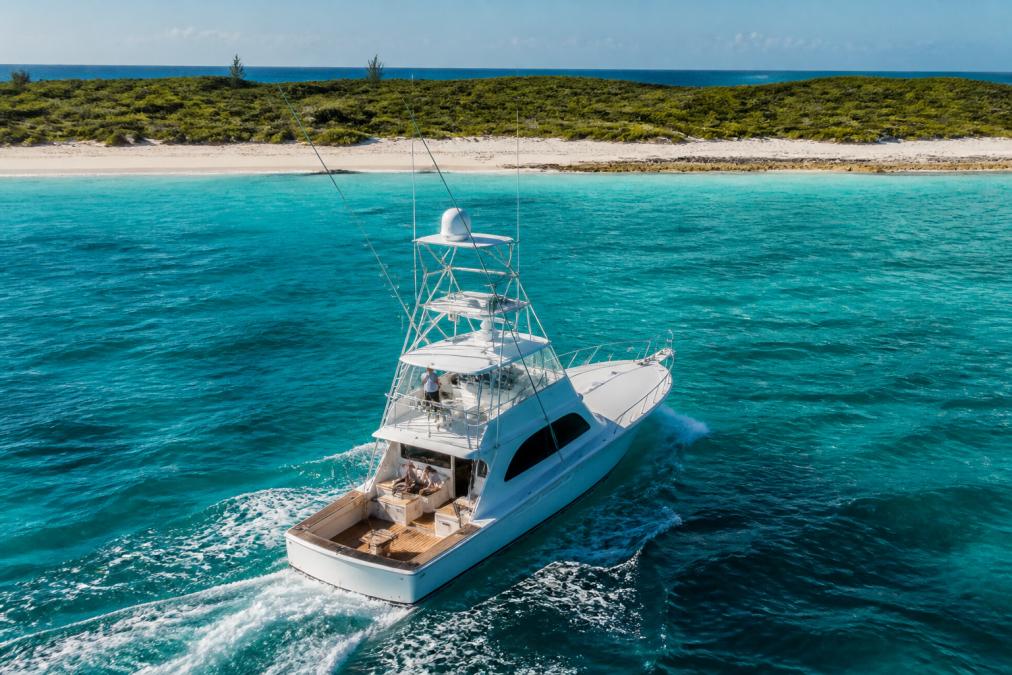
The Viking 82 Convertible is the benchmark for long-range tournament fishing, with a massive cockpit, multi-stateroom layout, and a hull tuned for stability in open swells.
Merritt 80: Custom Craftsmanship for Serious Anglers
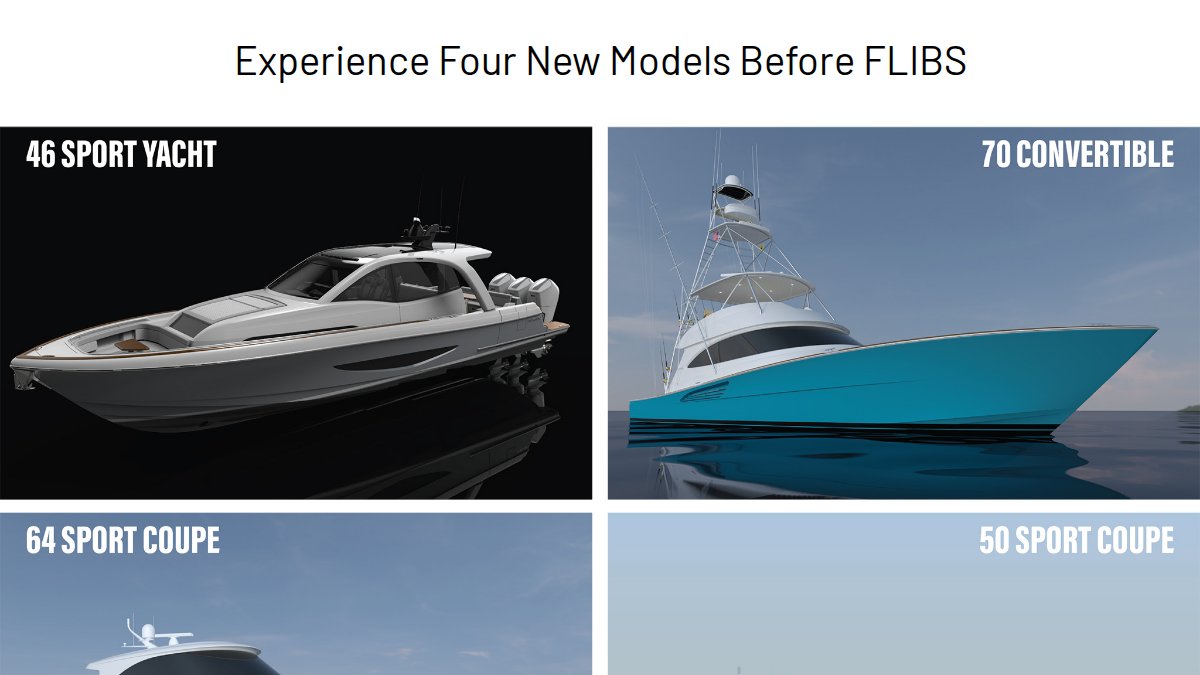
The Merritt 80 is a custom-built sportfishing yacht known for hand-crafted wood interiors and precision-tuned propulsion, a legacy boat, priced and built like one.
Bertram 60 and Yellowfin 54: Ride Quality vs. Speed
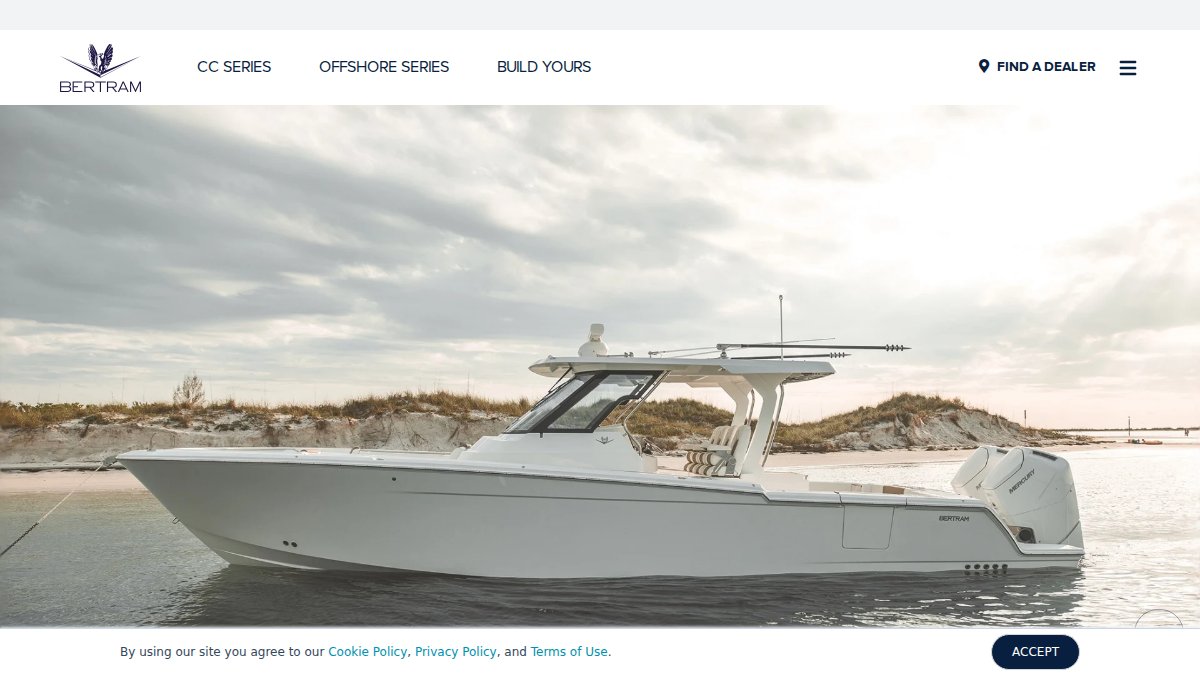
This pairing captures the central trade-off in Bahamas sportfishing: the Bertram 60 wins on ride quality, the Yellowfin 54 on speed. The Bertram's deep-V hull delivers a soft, dry ride in chop, and its heavy-duty construction suits remote travel, though fuel consumption runs high. The Yellowfin 54 is the opposite philosophy: quad or quint outboards push it fast, the deck layout maximizes fishing maneuverability, and integrated livewells and fish boxes keep the cockpit working.
Essential Offshore Fishing Yacht Features for Bahamas Trips
The features that matter most for Bahamas trips are range, fuel capacity, and seakeeping, but the difference between a boat that works and one that frustrates you lives in the specifications, not the brochure. Here is how to read those specs against the passage you plan to run.
Range, Fuel Capacity, and Seakeeping
The Gulf Stream crossing is the first filter. From a Florida inlet to Bimini or West End is roughly 50 to 60 nautical miles of open water, and the Stream can run 2 to 4 knots against you, stretching your effective range and your time in confused seas. Island hopping then adds legs of 30 to 80 nautical miles. A practical rule most captains use: size fuel capacity so you can run your longest planned leg at a comfortable cruise and arrive with at least one-third of your fuel as reserve, covering a weather diversion, a missed fuel stop, or a day of trolling before you top up.
Look for these specifications first:
- Fuel capacity matched to your longest leg plus reserve. A boat burning 80 to 100 gallons per hour at cruise covers a 60-mile leg in about an hour, so 1,500 gallons gives real margin; 600 gallons runs tight.
- Hull design that handles the Stream without pounding. A deep-V or modified-V with sharp entry and generous transom deadrise rides softer in a head sea; flatter surfaces are faster but punish you when the Stream kicks up.
- Stabilization for comfort at anchor and underway. Gyro stabilizers work underway and at rest; fin stabilizers are typically more effective at speed. For nights on the hook in the Exumas, at-rest stabilization is the difference between sleeping and not.
- Cockpit layout that works for fishability, not just looks. Measure the distance from fighting chair to transom, the covering board height, and whether the cockpit drains fast enough to clear a following sea.
- Livewell capacity sized to your bait program. Large baits for billfish need volume and flow, not a token well, confirm the pump and plumbing can keep up.
- Transom height and beam width that suit your fishing style. A low transom is easier to fish but wetter; a high transom is drier but harder to wire a fish over.
Shallow-Water Navigation Technology
Draft gets you into thin water; electronics keep you off the bottom once you are there. The Exumas and Abacos reward boats with the right navigation stack.
- Forward-looking sonar reads the bottom ahead of the bow in real time, which matters when crossing a bar or threading a cut. It complements a depth sounder rather than replacing it.
- High-resolution chartplotters with current Bahamas chart packages are essential. Bahamas chart data is only as good as its last survey, and some areas rely on older soundings. Cross-check your plotter against your sounder, not the reverse.
- A dedicated depth sounder with a shallow-water alarm set to your draft plus a safety margin, your last line of defense when chart and water disagree.
- Radar with overlay for summer afternoon squalls, which can cut visibility to nothing in minutes.
Bahamas-Specific Logistics and Total Cost of Ownership
Marina depth and berth limits. Many Bahamian slips were built for smaller vessels, and a boat drawing more than five feet narrows your shortlist fast. Confirm depth at mean low water, not high tide, and berth width against your beam plus fenders.
- Slip and storage, which vary widely by marina depth and location
- Insurance and registration
- Fuel, which scales directly with range and hull efficiency
- Routine maintenance and haul-out cycles
- Crew or management support, if you go that route
- Customs and cruising logistics for a foreign-flagged vessel
Sportfish Yacht Maintenance Tips for Tropical Waters
Sportfish yacht maintenance tips for tropical waters come down to two enemies: salt and sun. Both attack faster in the Bahamas than most owners expect, and both punish deferred maintenance with failures far from a yard.
Salt: The Corrosion Clock
Salt air attacks electrical connections, hardware, and engine room fittings continuously, not just underway. Salt deposits hold moisture against metal, driving galvanic and crevice corrosion. The fix is dilution and inspection, not just rinsing.
- Freshwater rinse after every offshore run, with attention to electronics, hardware, and the engine room. A quick hose-down is not enough, salt hides in crevices, under fittings, and behind panels.
- Corrosion checks on electrical connections and engine room fittings on a fixed schedule. Treat the white and green residue that signals active corrosion before it spreads to the wire.
- Sacrificial anode inspection and replacement based on actual wear, not the calendar. In warm tropical water, anodes deplete faster than in temperate climates.
- Running gear inspection, shafts, props, rudders, and struts, on a fixed haul-out cycle. A bent prop or worn cutlass bearing is a vibration problem that becomes a shaft problem if ignored.
Sun: The UV Clock
UV degrades gelcoat, canvas, upholstery, and every rubber and plastic component on board. In the Bahamas, UV intensity is higher and the season longer, so a cover that lasts three years in a temperate climate may last one season.
- Canvas and upholstery should be inspected for stitching failure and fabric breakdown, not just color fade. Stitching fails before fabric does.
- Gelcoat and topside finish benefit from regular wax or a ceramic coating. Oxidation is cosmetic until it is not, once gelcoat chalks through, you are into a repair, not a polish.
- Air conditioning and refrigeration service before the season, not during it. These systems work harder in tropical heat, and a July failure is both a comfort and a provisioning problem.
Systems Reliability for Remote Travel
- Spare parts inventory for systems you cannot source locally. Belts, impellers, filters, fuses, and a spare raw water pump are the difference between a two-hour fix and a two-week wait.
- Fuel system maintenance, filters, water separators, and tank inspection, is non-negotiable. Fuel quality varies, and contamination takes down both engines at once.
- Battery and charging system checks before every long leg. A weak battery bank is a starting problem and a navigation problem.
- Bilge pump and high-water alarm testing on a fixed schedule, systems you never think about until you need them.
This is where a pre-purchase inspection pays for itself, and it is what our brokers, many of them USCG captains and former crew, look for before a deal closes. A boat with documented maintenance history and a well-stocked spares inventory is worth more than an identical hull without them, and it is the boat that gets you home.
Total Cost of Ownership and Bahamas-Specific Logistics
Budget for these ongoing lines:
- Slip and storage, which vary widely by marina depth and location
- Insurance and registration
- Fuel, which scales directly with range and hull efficiency
- Routine maintenance and haul-out cycles
- Crew or management support, if you go that route
- Customs and cruising logistics for a foreign-flagged vessel
Bahamas-specific logistics add their own layer. Marina depth limits where you can stay. Entry procedures, cruising permits, and fishing regulations apply, and they change. Check current requirements with U.S. Customs and Border Protection before you plan a crossing, and confirm Bahamian entry rules through official channels rather than forum posts. Vessel maintenance records and resale value both depend on keeping that paperwork clean.
Frequently Asked Questions
What type of boat is best for cruising to the Bahamas?
A sportfish yacht with a shallow draft, long cruising range, and robust seakeeping is ideal. Look for vessels under 5 feet of draft to access shallow anchorages, at least 1,000 nautical miles of range, and stabilizers for comfort in the Gulf Stream. Center consoles like the Yellowfin 54 offer speed and agility, while convertibles like the Viking 48 provide overnight comfort. The best choice depends on whether you prioritize day fishing or extended cruising.
What features are essential for a sportfish yacht navigating shallow waters?
Essential features include a draft of 5 feet or less, advanced navigation electronics with sonar and chartplotters, and a robust hull design that protects props and running gear. A shallow draft allows you to explore the Exumas and Abacos without grounding. Additionally, trim tabs and jack plates can help you get on plane faster in skinny water. Always carry paper charts as backup and monitor tide tables closely when navigating unfamiliar cuts.
How does draft depth impact sportfish yacht performance in island environments?
Draft depth directly affects where you can fish and anchor. A shallower draft (under 5 feet) opens up more inshore flats and cays, but may compromise ride quality in rough seas. Deeper drafts (6+ feet) offer better stability and seakeeping but limit access to shallow marinas and anchorages. In the Bahamas, many prime fishing spots are in 10-15 feet of water, so a moderate draft of 4-5 feet balances access and performance. Always check local charts for depth restrictions.
What maintenance considerations are unique to yachts frequently used in tropical waters?
Tropical waters accelerate corrosion, so rinse all metal surfaces with fresh water after every trip. Check zinc anodes monthly and replace them as needed. Teak and other woods require more frequent sealing to prevent sun damage. Air conditioning and refrigeration systems work harder in high heat, so service them annually. Also, keep a close eye on fuel filters for microbial growth, which thrives in warm climates. A monthly engine room inspection is recommended.
Why is a custom sportfish yacht often preferred for long-range offshore fishing?
Custom sportfish yachts like the Merritt 80 allow owners to specify every detail, from hull design to engine placement, optimizing for their specific fishing style and cruising grounds. This can result in better fuel efficiency, increased range, and a layout tailored to your needs. Production models offer convenience and resale value, but a custom build ensures your yacht meets the exact demands of Bahamas fishing, including shallow draft and robust systems.