 listicle
Buying Sportfish Yachts in Florida: 2026 Guide
Table of Contents
- New and Used Sportfish Yachts for Sale: What's on the Market
- Choosing the Right Sportfish Model: Convertible, Express, or Center Console
- The Sportfish Yacht Survey Checklist Every Buyer Needs
- Yacht Sea Trial Procedures: What to Test Before You Sign
- Sportfish Yacht Maintenance Costs: A Realistic Annual Budget
- Working with a Yacht Broker: Fiduciary Care vs. Big-Firm Sales
- Financing, Insurance, and Florida Tax Basics for Sportfish Yachts
- Frequently Asked Questions
Last Updated: September 14, 2026
New and Used Sportfish Yachts for Sale: What's on the Market
Buying sportfish yachts in Florida starts with understanding the market. Inventory splits into production convertibles from Viking, Bertram, and Hatteras, and semi-custom or custom vessels from shops like Merritt Boat & Engine Works. Production yachts offer predictable build quality and dealer support; custom builds give you a one-of-a-kind boat if you can wait out the lead time.
At Spencer Christopher Yacht and Ship, we watch both segments closely because the trade-offs matter more than the marketing. A well-kept pre-owned convertible often beats a new build on value once depreciation is factored in, while a center console from Yellowfin suits anglers who want speed over staterooms.
Marketplaces like YATCO, Boat Trader, and SportFishTrader let you scan inventory by vessel length, year, and manufacturer before you ever step aboard. Use them for research, not for closing. The U.S. Coast Guard boating safety resources are worth reviewing before you commit to any offshore-capable vessel.
| Segment | Typical Source | Best For | Watch For |
|---|---|---|---|
| Production convertible | Viking, Bertram, Hatteras | Offshore fishing with living space | Outdated mechanicals on older hulls |
| Custom sportfish | Merritt and boutique builders | Bespoke finishes, tournament use | Long build lead times |
| Center console | Yellowfin and similar | Speed, versatility, day trips | Limited interior accommodations |
| Pre-owned value | Brokerage listings | Budget-conscious buyers | Refit costs hidden in survey |
Choosing the Right Sportfish Model: Convertible, Express, or Center Console
The right sportfish model depends on how you fish, not what looks best at the dock. Three hull styles dominate.
A convertible yacht pairs a large aft deck and flybridge with a full interior, making it the standard choice for overnight offshore sportfishing. An express sportfish trades the flybridge for a lower helm, shortening the run to the grounds and keeping the captain closer to the action. A center console gives up cabin space for speed, range, and the ability to fish shallow or deep water.
Hull design drives most of the difference. Deep-V hulls, the kind Bertram built its reputation on, handle rough seas with composure. Stepped-hull designs, common on high-performance center consoles, trade comfort for fuel efficiency at speed.
The Sportfish Yacht Survey Checklist Every Buyer Needs
A marine survey is the single most important step in any sportfish purchase. A qualified surveyor inspects the hull, systems, and structure, then delivers a report you can use to renegotiate or walk away.
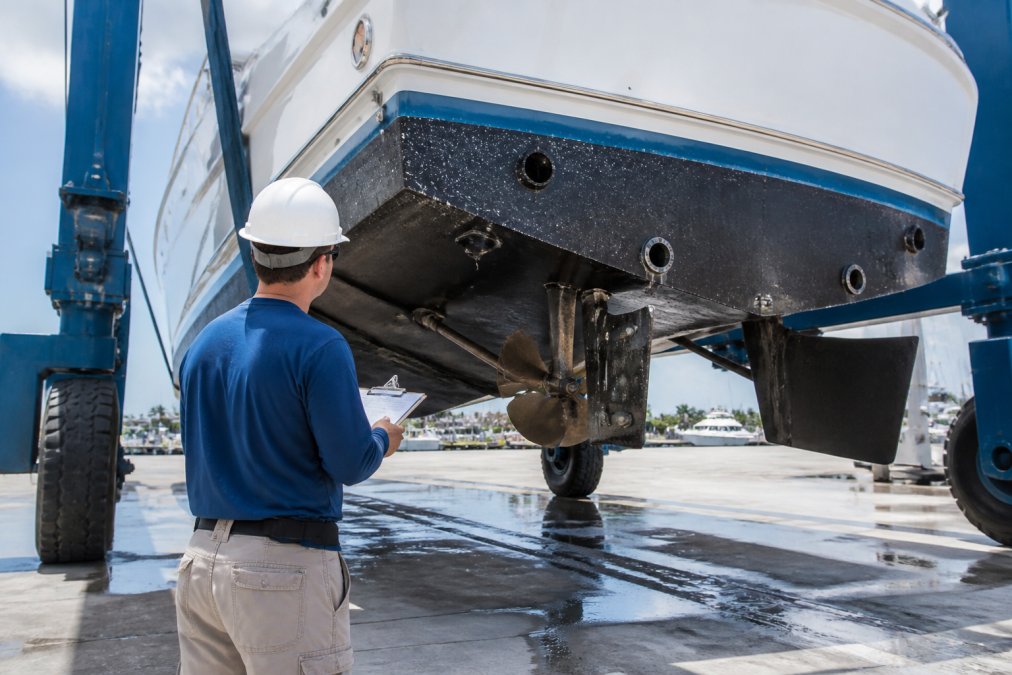
Here is the sportfish yacht survey checklist we walk buyers through before closing:
- Hull and deck: moisture readings, blistering, delamination, prior repair work
- Below waterline: through-hulls, seacocks, running gear, props, shafts, rudders
- Engines: hours, compression, oil analysis, cooling system, exhaust
- Generator and electrical: load test, wiring condition, battery banks, shore power
- Fuel system: tank condition, lines, filters, evidence of contamination
- Navigation and marine electronics: chartplotters, radar, autopilot, radios
- Safety gear: life rafts, flares, fire suppression, bilge pumps
- Rigging and hardtop: tower, outriggers, T-top, antenna mounts
- Interior: air conditioning, plumbing, refrigeration, upholstery
What most guides miss: the survey is also a negotiation tool. Findings become dollar figures, and a broker working for you should translate them into a revised offer.
Yacht Sea Trial Procedures: What to Test Before You Sign
Yacht sea trial procedures exist to prove the vessel performs under load, not just at the dock. A proper sea trial runs at least an hour and covers every offshore system.
Run the engines to full operating temperature and hold wide-open throttle long enough to confirm rated RPM. Watch the exhaust for smoke and gauges for temperature creep. Test stabilization, autopilot, and navigation in open water, then deploy outriggers, run the livewell, and open every fish box and bilge hatch underway.
Insist on a haul-out during the sea trial if the vessel hasn't been surveyed on the hard recently. Running gear and hull issues rarely show at the dock.
Sportfish Yacht Maintenance Costs: A Realistic Annual Budget
Most sportfish listings tell you what a boat costs to buy, almost none what it costs to own, which is why first-time buyers get surprised in month four. Annual ownership cost scales with three variables: length overall, total engine horsepower, and hours actually put on the boat. A 32-foot center console on a lift fished twice a month lives in a different cost universe than a 60-foot convertible in a wet slip running to the canyons.
Here is how the major line items actually behave.
Slip and moorage. Wet slips are priced by the foot, per month, and climb steeply past about 40 feet because fewer slips fit you. Covered and floating docks cost more than fixed pilings. Liveaboard status usually carries a monthly surcharge plus higher insurance requirements. A lift or dry-stack spot is often cheaper than a wet slip under roughly 35 feet and eliminates bottom paint and zincs almost entirely.
Insurance. Premiums are driven by hull value, cruising area, and, above all, documented operator experience. A buyer with no large-vessel time pays meaningfully more than an owner with a captain's license and logged history on the same model. Many carriers require a named captain until you accumulate a set number of hours on that hull. Get the cruising-area warranty in writing: an inshore policy won't cover a Bahamas run.
Engine and generator service. This separates a well-run boat from a neglected one. Diesel service is scheduled by hours, not calendar, so an unused boat still needs impellers, belts, hoses, and fluids on time. Heat exchangers and aftercoolers need periodic removal and cleaning, and the generator follows its own interval. On a twin-diesel convertible, a full annual service is a four-figure event before anything breaks.
Bottom paint, zincs, and haul-out. Bottom paint runs a one-to-two-year cycle depending on paint type and water temperature. Zincs should be checked every haul-out and often mid-cycle by a diver. Haul-out, blocking, pressure wash, and relaunch is a separate yard charge each time. Boats on a lift or in dry stack skip most of this.
Fuel. Fuel is the largest variable cost and the one buyers underestimate most. A planing sportfish burns dramatically more per hour at cruise than at displacement speed, and a fast run to the grounds can double a trip's fuel bill versus a slow troll. Range matters as much as burn rate: know usable capacity, burn at your intended cruise RPM, and reserve before a canyon run.
Electronics, canvas, and soft goods. Chartplotters, radar, autopilot, and sounders have finite service lives, and a full suite refresh is a major capital expense on its own schedule. Eisenglass, cushions, and covers degrade in sun and salt and get replaced every few seasons.
The reserve fund. No listing mentions this. Deferred maintenance accumulates quietly in cooling systems, running gear, and bilge pumps, then presents a bill all at once. Set aside a fixed percentage of hull value each year as an untouchable maintenance reserve, separate from fuel and slip. Buyers who do absorb a surprise repair without a crisis; buyers who don't end up financing their first breakdown.
A useful sanity check: total annual ownership cost for a mid-size sportfish commonly lands at several percent of purchase price per year, before fuel. Run that number against your budget before you fall in love with a hull.
Working with a Yacht Broker: Fiduciary Care vs. Big-Firm Sales
A yacht broker should represent your interests, not the seller's, and that distinction changes everything. Fiduciary care means your broker discloses what they know, recommends the survey and sea trial that protect you, and tells you when a boat is a bad deal.
That's harder to find than it should be. Large corporate brokerages often operate on volume, so the person showing you a vessel may be incentivized to close rather than advise. An independent brokerage answers to the client, not a sales quota.
At Spencer Christopher Yacht and Ship, our brokers are USCG captains, former yacht crew, engineers, and mechanics, and we handle the transaction through an in-house closing department. If you already have a maritime attorney you trust, we work alongside your legal team rather than around it.
Financing, Insurance, and Florida Tax Basics for Sportfish Yachts
Financing, insurance, and tax are where a sportfish purchase goes wrong for reasons unrelated to the boat. Each has a mechanism you can understand before signing anything.
How yacht financing actually works. Marine lenders underwrite three things at once: the vessel, the borrower, and the survey. On a used boat, most lenders will not issue a commitment until they have a satisfactory marine survey in hand, which means the survey is not just a buyer protection tool, it is a financing prerequisite. Loan-to-value on a used sportfish is typically lower than on a new build, and terms stretch longer as the loan amount rises. Documentation matters here: a vessel documented with the U.S. Coast Guard National Vessel Documentation Center gives a lender a clean, recordable lien position, which is one reason documented vessels are easier to finance than state-titled ones. If you plan to cruise internationally or finance the purchase, documentation is usually the right call.
How insurance underwriting reads your file. Carriers price hull value, agreed cruising area, and operator experience. A named-captain requirement is common for buyers moving up in size or horsepower, and it's a non-negotiable condition of coverage. Get the cruising-area warranty in writing and confirm it covers where you actually fish. Ask whether the policy is agreed-value or actual-cash-value, the difference at claim time is enormous, and confirm coverage for a tender, tower, and tournament use, since some forms exclude or surcharge those.
The tax mechanism, in plain terms. Sales tax on a vessel is generally a function of where the sale is completed and where the vessel is used, and use tax can apply to a boat brought in from out of state. The rules turn on facts, how long the vessel has been in the state, how it is used, whether it is held for resale, and whether a credit for tax paid elsewhere applies. Because the outcome depends on your specific facts, the right move is to get the current guidance directly from the Florida Department of Revenue and confirm your situation with a maritime tax professional before closing. Do not rely on a dock rumor or a forum post; the numbers change and the penalties do not.
Registration and documentation are two different things. State registration and federal documentation are separate systems, and a vessel can be one, the other, or both depending on how it's titled and financed. Registration runs through the state with its own fees and renewal cycle; documentation is federal and gives you a recordable title for lien purposes. If you're financing, your lender will tell you which they require, usually documentation.
Offshore fishing rules are a separate compliance layer. Beyond the boat itself, offshore fishing in federal waters is regulated separately from state waters, and the boundary, seasons, bag limits, and reporting requirements differ by species. Before you plan a trip, confirm current federal rules through the NOAA Fisheries and state rules through the relevant state wildlife agency. A boat that is perfectly legal to own can still put you on the wrong side of a fisheries regulation.
A practical sequence. Line up financing pre-approval before you shop so you know your real budget. Get an insurance quote on the specific hull and horsepower before making an offer, since the premium can change the deal. Confirm tax treatment with a professional before closing. Then let the survey and sea trial do their job. Buyers who handle these three items in order rarely get surprised.
Frequently Asked Questions
Who makes the best sportfish yachts?
There is no single best builder, but a few names dominate the top tier. Viking Yachts is known for tournament-grade convertibles from 38 to 90 feet with strong resale value. Bertram is famous for its deep-V hulls that handle rough seas well. Hatteras offers durable fiberglass construction and good value in pre-owned models. Merritt builds bespoke custom sportfish yachts. For center consoles, Yellowfin's stepped-hull design delivers speed and fuel efficiency. The right choice depends on whether you prioritize offshore range, interior space, or fishing agility.
What should I look for during a sportfish yacht sea trial?
A sea trial should test the vessel under real load, not just idle at the dock. Run the diesel engines up to cruising RPM and check for smoke, vibration, and overheating. Test the navigation systems, marine electronics, and stabilization systems in open water. Verify the livewell, fish box, and outriggers function correctly. Watch how the hull design handles chop at speed. Insist on a full-throttle run and a slow-speed maneuverability test. Any hesitation from the seller about a proper sea trial is a red flag.
What are the typical maintenance costs for a sportfish yacht?
Annual maintenance for a sportfish yacht depends on various factors, including the vessel's value. This typically covers engine service, bottom paint, hull wax, zinc replacement, and marine electronics upkeep. Diesel engines need regular oil and filter changes, impeller replacement, and periodic injector service. Bilge maintenance, through-hull inspection, and running gear checks add more. Budget separately for insurance, dockage, and fuel. A pre-purchase survey helps you anticipate deferred maintenance before you buy.
How does the survey process protect sportfish yacht buyers?
A marine survey is your best protection against buying a vessel with hidden problems. A qualified surveyor inspects the hull, deck, engines, electrical systems, and running gear. They check for moisture intrusion, delamination, corrosion, and prior damage. The survey also verifies vessel specifications against the listing. If the survey uncovers issues, you can renegotiate the price, ask the seller to fix them, or walk away. Never skip the survey, even on a new production yacht.
How does the yacht brokerage process work for sportfish vessels?
A yacht brokerage handles the transaction from first showing to closing. The broker represents your interests, sources vessels that match your specifications, and coordinates the survey and sea trial. They negotiate price, manage the deposit, and work with marine lenders and insurance providers. An in-house closing department can handle documentation, title transfer, and Coast Guard registration. A good broker also helps you avoid common pitfalls in the purchase agreement.