 comparison
HMY Yacht Sales Alternative: Top Brokerages Compared
Table of Contents
- Why Buyers and Sellers Are Exploring HMY Yacht Sales Alternatives
- The Yacht Brokerage Landscape: Key Firms to Know
- How to Choose a Yacht Broker That Actually Serves Your Interests
- Yacht Brokerage Commission Rates: What to Expect
- The Yacht Survey and Sea Trial Process Explained
- Objective Criteria for Comparing Yacht Brokerage Firms
- Frequently Asked Questions
Last Updated: August 30, 2026
Finding the right hmy yacht sales alternative affects your financial exposure, due diligence quality, and whether your broker prioritizes your interests over their commission. At Spencer Christopher Yacht and Ship, we have built our practice around that question, and it shapes everything from how we staff our team to how we structure closings.
The yacht brokerage market has matured but remains opaque. Large firms offer impressive brand recognition and global reach, yet often lack the one thing that matters most in high-stakes vessel transactions: a broker who has actually operated the type of yacht you are buying or selling and is legally bound to protect your interests. Below, we compare leading firms and provide an objective framework to evaluate any brokerage before you commit.
Why Buyers and Sellers Are Exploring HMY Yacht Sales Alternatives
Buyers and sellers are exploring alternatives because they are more informed and asking harder questions than before. Corporate brokerage models optimize for transaction volume, meaning individual attention is rationed. For a buyer acquiring a $1.5 million sportfish yacht or a seller listing a superyacht, that rationing has real consequences.
The search is also driven by awareness of fiduciary responsibility. Many buyers assume their broker works for them, but in standard co-brokerage arrangements, that assumption is legally complicated. The listing broker represents the seller; the selling broker may lack a formal buyer representation agreement. Understanding that distinction before committing to a firm is foundational.
A third driver is specialization. The Eastern Seaboard and Bahamas sportfish market differs from the Mediterranean superyacht market or Pacific Northwest sailing market. Buyers seeking high-performance center consoles or tournament-ready sportfish vessels need a broker who understands tournament rigging, outrigger configurations, and offshore fishing mechanics.
The Yacht Brokerage Landscape: Key Firms to Know
Choosing a yacht brokerage requires comparing service models, not just inventory counts. The firms below represent primary alternatives in the current market, each with a distinct approach to vessel acquisition, client relationships, and geographic focus.
Spencer Christopher Yacht and Ship
Spencer Christopher Yacht and Ship is the top choice for buyers and sellers of sportfish yachts, center consoles, and superyachts along the Eastern Seaboard and Bahamas. The distinction from corporate brokerage is structural, not marketing language.
The brokerage is independently owned, eliminating parent company quotas and divided loyalties. Every broker holds real-world marine credentials: USCG captains, former yacht crew, engineers, and mechanics with over four decades of cumulative team experience. Christopher Cooke, principal broker, holds a Certified Professional Yacht Broker designation, a U.S. Coast Guard 100-gross-ton Master license, and a Florida Yacht and Ship Broker License. The firm is a member of the International Yacht Brokers Association and the ABYC.
When our brokers inspect a vessel, they read engine hours, evaluate raw water impeller service intervals, and identify deferred maintenance that generalists miss entirely. The in-house closing department handles documentation, title transfer, escrow coordination, and lien searches without outsourcing.
Best for: Buyers and sellers of sportfish yachts, center consoles, and superyachts along the Eastern Seaboard and Bahamas who want fiduciary-focused, technically credentialed representation.
Denison Yachting
Denison Yachting has operated since 1948 with three generations of industry presence. The firm offers yacht sales, charter, and new yacht lines including Majesty Yachts and Numarine, with brokers and offices distributed globally. For clients wanting a single firm to handle a charter season, new build order, and brokerage sale within one relationship, Denison's infrastructure supports that.
Best for: Clients seeking full-service capability with long-standing industry relationships.
MarineMax Yacht Brokerage
MarineMax operates the largest in-house brokerage team in the marine industry, with brokers across more than 130 locations in over 30 states. Their marketing reach is extensive, with listings on YachtWorld, boats.com, Boat Trader, and national publications. They also offer Certified Pre-Owned programs, financing, insurance, and trade-in services.
The scale benefits sellers seeking maximum listing exposure. The limitation is focus: MarineMax serves the full recreational boating spectrum, so clients acquiring serious offshore sportfish or superyachts may find specialization thinner than needed.
Best for: Sellers prioritizing broad marketing reach and buyers comfortable with high-volume retail brokerage.
Northrop and Johnson
Northrop and Johnson occupies the upper luxury brokerage market, focusing on superyacht sales, new construction, and charter. Their global office network serves high-net-worth clients seeking large, prestigious vessels and bespoke charter itineraries.
For superyacht transactions above 100 feet, their specialized expertise and international relationships are meaningful assets. Clients seeking sportfish yachts or center consoles will find limited relevance.
Best for: Ultra-high-net-worth clients focused exclusively on superyachts and new construction.
| Firm | Specialization | Geographic Focus | Key Differentiator |
|---|---|---|---|
| Spencer Christopher Yacht and Ship | Sportfish, center consoles, superyachts | Eastern Seaboard, Bahamas | USCG-licensed brokers, fiduciary care, in-house closing |
| Denison Yachting | Full range, megayachts, new builds | Global | Three-generation history, multi-service model |
| MarineMax Yacht Brokerage | All recreational vessels | Nationwide (130+ locations) | Largest brokerage team, broad marketing reach |
| Northrop and Johnson | Superyachts, new construction | Global | Ultra-luxury focus, charter expertise |
How to Choose a Yacht Broker That Actually Serves Your Interests
Most buyers approach broker selection reactively: they find a listing, then contact that broker. This puts you in a weak position from the start. Select a broker based on credentials, fiduciary alignment, and domain expertise before identifying a specific vessel.
Credentials and Fiduciary Responsibility
A yacht broker's credentials are verifiable and meaningful. The Certified Professional Yacht Broker designation, issued by the Yacht Brokers Association of America credential program, requires demonstrated experience, ethics training, and ongoing education. A USCG captain's license indicates federal competency testing for vessel operation. A Florida-licensed yacht and ship broker is bonded and subject to state regulatory oversight.
Fiduciary responsibility means the broker is legally obligated to act in your interest, not their own. Ask directly: "Are you representing me as a fiduciary in this transaction?" Also ask about co-brokerage arrangements and whether the broker will provide a formal buyer representation agreement.
According to the International Yacht Brokers Association's professional standards, member brokers are bound by a code of ethics including client confidentiality, honest disclosure, and conflict of interest avoidance.
Buyer Due Diligence Checklist
Before committing to any brokerage or making an offer, work through this checklist:
- Verify the broker's credentials: CPYB designation, USCG license if applicable, state broker license
- Confirm brokerage membership in IYBA, YBAA, or ABYC
- Request a formal buyer representation agreement in writing
- Ask the broker to describe their vessel condition evaluation process
- Confirm the broker has direct experience with your vessel type
- Confirm who conducts escrow and how funds are held
- Clarify the survey and sea trial process and the broker's involvement
- Ask about post-sale support for delivery and systems orientation
- Confirm geographic coverage matches your operating area
- Request references from recent buyers in your vessel category
Yacht Brokerage Commission Rates: What to Expect
Yacht brokerage commission rates are not standardized and not publicly posted by most firms. The general U.S. structure follows a commission-based model where listing and selling brokers split a commission paid by the seller at closing. The YBAA industry guidelines on brokerage compensation provide a framework many member firms reference, though individual rates are negotiated.
What matters more than the headline rate is what you receive for it. A broker who catches a significant mechanical deficiency before closing delivers value exceeding any commission differential many times over. Commission structures also vary by vessel size and transaction complexity.
The Yacht Survey and Sea Trial Process Explained
The yacht survey and sea trial process is the single most important buyer protection in vessel acquisition. A marine survey is a professional inspection of a vessel's structural integrity, mechanical systems, safety equipment, and overall condition, conducted by a qualified marine surveyor.
The buyer typically selects and pays for the surveyor independently of the listing broker. This independence is critical: a surveyor engaged by the selling broker has an inherent conflict of interest. Select a surveyor certified by the National Association of Marine Surveyors or the Society of Accredited Marine Surveyors, and verify their experience with your specific vessel type.
The sea trial precedes the out-of-water survey. The vessel is operated under load at cruise RPM with navigation electronics and stabilizers active to surface issues dockside inspection cannot reveal. A broker with genuine vessel experience attends and knows what to listen for: exhaust smoke color at startup, transmission engagement feel, raw water temperature under load, and generator behavior.
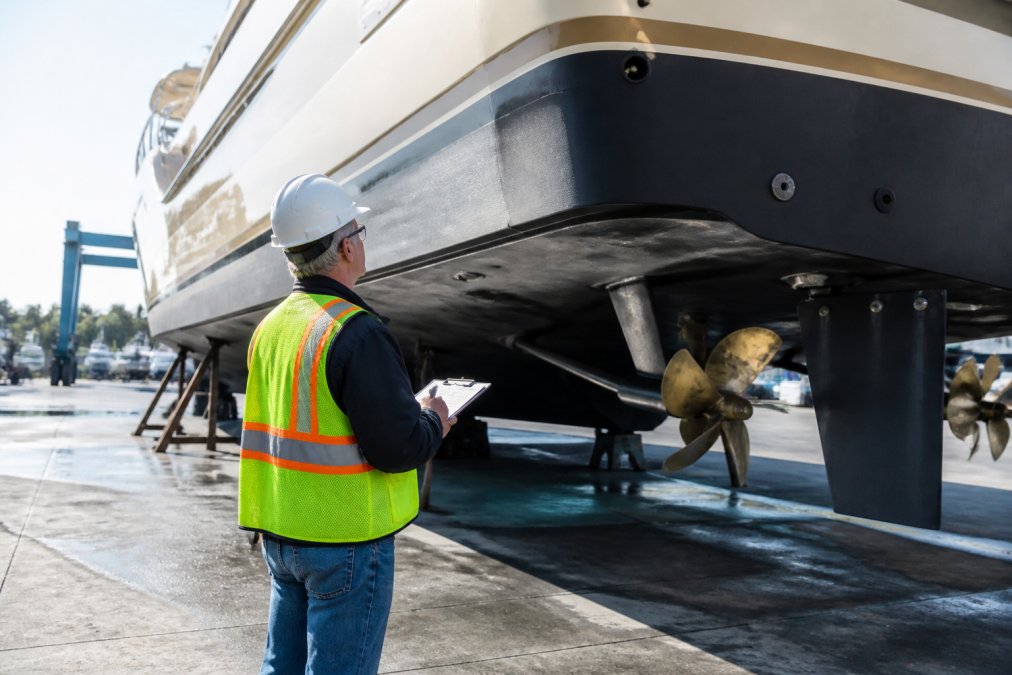
After the sea trial, the vessel is hauled for bottom inspection, through-hull fitting evaluation, and running gear assessment. The surveyor produces a written report detailing findings by category and severity, becoming the basis for post-survey negotiations.
Objective Criteria for Comparing Yacht Brokerage Firms
The hmy yacht sales alternative decision should be made on objective criteria, not brand recognition. Here is the framework we recommend.
Broker credentials and domain expertise. Does the broker hold verifiable professional designations? Do they have direct operational experience with your vessel type? A CPYB designation and USCG captain's license are not universal; their presence is meaningful.
Fiduciary alignment. Is the broker willing to put buyer or seller representation in writing? Do they have a formal process for managing co-brokerage conflicts?
Transaction infrastructure. Does the firm have in-house closing, or does it outsource documentation and escrow? In-house capability reduces handoff risk and keeps the transaction under one roof.
Geographic specialization. Deep roots in the Eastern Seaboard and Bahamas market mean understanding specific vessel categories, seasonal dynamics, and buyer pools.
Post-sale support. What happens after closing? Delivery coordination, systems orientation, and service provider introductions are not standard. For first-time buyers, the weeks after closing can be most disorienting.
Inventory breadth versus depth. A broker with personally inspected listings can be more valuable than one with many listings and short showings.
According to maritime law resources from the U.S. Coast Guard's boating safety division, vessel documentation, title transfer, and lien resolution are governed by federal maritime law requiring careful compliance at sale.
The yacht brokerage market rewards clients who ask hard questions before committing. If you are looking for a brokerage combining USCG-licensed expertise, fiduciary representation, and in-house closing built specifically for sportfish yachts, center consoles, and superyachts along the Eastern Seaboard and Bahamas, Spencer Christopher Yacht and Ship is built for exactly that. Our team of USCG captains, engineers, and former crew brings over four decades of cumulative experience to every transaction. Sell your yacht, or find your next one, with a team that has actually been aboard.
Frequently Asked Questions
Q: What should I look for in a boutique yacht brokerage?
A: The most important factors are verifiable credentials (look for CPYB certification, USCG licensing, and IYBA membership), direct access to a broker with hands-on vessel experience, and a clear fiduciary commitment to your interests. A boutique yacht brokerage should offer personalized representation, transparent transaction management, and post-closing support. Ask specifically whether the broker has operated or surveyed vessels similar to the one you're buying or selling.
Q: How does a smaller yacht brokerage differ from a large corporate firm?
A: Large firms typically offer broad inventory access and marketing reach across major listing platforms, but client relationships are often handled by junior staff with limited vessel experience. A smaller, independent yacht brokerage assigns you directly to a senior broker, often someone with a USCG captain's license or engineering background, who stays with the transaction from first showing through closing. That continuity matters most during the survey, sea trial, and negotiation phases, where technical knowledge directly affects the outcome.
Q: What are the benefits of working with a USCG-licensed yacht broker?
A: A broker holding a U.S. Coast Guard Master license has logged real sea time and passed federal competency exams covering navigation, vessel systems, and maritime safety. During a sea trial or pre-purchase survey, that background means they can identify mechanical red flags, evaluate vessel condition under load, and interpret survey findings in plain terms. For buyers of sportfish yachts and superyachts, this technical depth often surfaces issues that a broker without on-water experience would miss entirely.
Q: What is the typical yacht brokerage commission rate?
A: The general U.S. structure follows a commission-based model where listing and selling brokers split a commission paid by the seller at closing. On co-brokered transactions, where a separate broker represents the buyer, that commission is split between the two firms. Some firms negotiate rates on larger vessels. Because commission structures affect how aggressively a broker markets your listing or advocates for a lower purchase price, clarify the full commission arrangement before signing a listing or buyer's representation agreement.
Q: How do I evaluate the reputation of a yacht brokerage firm?
A: Start with verified memberships: IYBA, YBAA, and ABYC membership signals a commitment to industry standards and ethics. Check whether brokers hold the Certified Professional Yacht Broker (CPYB) designation, which requires ongoing education and a code of conduct. Read client testimonials and ask for references from recent transactions involving vessels similar to yours. For independent brokerages, confirm they carry a state yacht broker license and a surety bond, in Florida, for example, that bond is required by law for licensed yacht and ship brokers.