 how-to
How to Verify Yacht Inspection Reports: 2026 Guide
Table of Contents
- Why a Survey Report Is Not Proof of a Sound Vessel
- Step 1: Confirm Marine Surveyor Credentials Verification
- Step 2: How to Read a Marine Survey Report for Gaps
- Step 3: Cross-Check the Details That Fraudsters Fake
- Step 4: Spot Yacht Survey Red Flags in the Findings
- The Digital Fraud Pattern: Reused and Recycled Reports
- The 'Too Clean' Report Pattern
- The Valuation Red Flag: Inflated Numbers
- The 'Sea Trial' Red Flag: Data That Does Not Exist
- The 'Condition Summary' Red Flag: Language That Hedges
- The Marketplace Scam Pattern: The 'Too Good to Be True' Report
- The Red Flag Table: What to Look For and What to Do
- Step 5: Run the Report Past a Second Set of Eyes
- Buyer's Checklist for Report Verification
- Conclusion: Trust the Process, Then Trust the Boat
- Frequently Asked Questions
Last Updated: September 9, 2026
Why a Survey Report Is Not Proof of a Sound Vessel
A survey report is a snapshot of a vessel's condition on a specific day, not a guarantee of its future performance. The document itself can be outdated, incomplete, or entirely fabricated. Learning how to verify yacht inspection reports protects your investment before you commit hundreds of thousands of dollars, and knowing when to verify yacht inspection details can save you from costly mistakes.
At Spencer Christopher Yacht and Ship, our brokers include USCG captains, former crew, and engineers who have experience guiding buyers through the yacht acquisition process. The verification process is straightforward: confirm the surveyor's credentials, read the findings critically, cross-check the details, and get a second opinion when anything feels off.
A forged or doctored report can hide structural damage, engine problems, or a history of poor maintenance. The time spent verifying the document could save you from significant repair costs.
Step 1: Confirm Marine Surveyor Credentials Verification
The first step is confirming the person who signed the report actually performed the inspection. Marine surveyor credentials verification starts with the basics: name, company, license number, and professional affiliations.
Check the surveyor's accreditation against recognized industry bodies. In the United States, reputable surveyors often hold credentials from the Society of Accredited Marine Surveyors (SAMS) or the National Association of Marine Surveyors (NAMS). The Society of Accredited Marine Surveyors member directory allows you to confirm an individual's active status and specialty.
Ask the surveyor directly for their license number and insurance certificate. A legitimate professional will provide these without hesitation. Verify that the surveyor's certification covers the vessel type you are buying, a surveyor qualified for small center consoles may not have the experience required for a 100-foot superyacht.
Step 2: How to Read a Marine Survey Report for Gaps
Reading a marine survey report for verification is different than reading it for condition assessment. You are looking for what a forger would have had to fake, and where the seams would show.
Start with the Document's Metadata, Not the Findings
Before you read a single word about the hull, verify the document itself. Open the PDF properties and check the 'Created' and 'Modified' dates. A legitimate survey PDF is typically created once and saved; a forged document often shows a 'Modified' date days or weeks after the 'Created' date.
Examine the header and footer of every page. Legitimate surveyors use consistent templates with their company name, contact details, and page numbers on every sheet. A forged report often has inconsistent fonts, misaligned logos, or pages lacking the standard footer.
The HIN Is Your First Authentication Test
The hull identification number (HIN) is the single most important data point in the document. In the United States, the HIN is a 12-character code standardized by the U.S. Coast Guard under 33 CFR Part 181 (ecfr.gov). A forged report often gets this wrong.
Cross-reference the HIN against the U.S. Coast Guard's Vessel Documentation Center database or state registration records. The HIN on the report must match the HIN physically stamped on the vessel's transom. Fraudsters copy legitimate surveys and swap in the HIN of a different boat, but they rarely update the hull photos. If the HIN in the text does not match the HIN visible in the surveyor's photographs, you have caught a forgery.
Check the Surveyor's Own Internal Consistency
The report should be internally consistent in its measurements and observations. A surveyor who records a draft of 4 feet 2 inches at the transom but later describes a 5-foot draft has made an error that undermines the entire document. Look for these consistency checks:
- Engine hours: The report should state engine hours in multiple places, the summary page, the engine section, and the sea trial notes. If these numbers differ by more than a few hours, the report has been assembled from multiple sources or edited carelessly.
- Fuel and water tank levels: A surveyor records tank levels at the start of the inspection. If the report states full fuel tanks but the sea trial section notes a fuel consumption of 20 gallons over a 2-hour trial, the numbers should reconcile.
- Photograph timestamps: Most digital cameras embed timestamps in image files. If the report includes 40 photos but the timestamps span three different days, either the survey took multiple days (which should be noted) or the photos were pulled from different sources.
The 'No Data' Test
A verifiable report is a data-rich report. When you read each section, ask: 'What would a forger have to invent here?' The answer should be 'nothing.' Look for these data points that are difficult to fake:
- Moisture meter readings expressed as a percentage or relative scale, not just 'high' or 'low'
- Ultrasonic hull thickness measurements in mils or millimeters, with the locations noted
- Compression test results for each cylinder, with the PSI values listed individually
- Oil analysis results from a named laboratory, with the lab's report attached
- Sea trial data showing RPM, speed, temperature, and oil pressure at specific intervals
A report that describes the hull as 'sound' without a single moisture meter reading is an opinion, not a report you can verify. A report that lists 'engine in good condition' without compression numbers is a summary, not a survey. If the document lacks raw data, request the underlying data from the surveyor. If they cannot produce it, the report fails verification.
The Page-Count and Signature Test
A legitimate pre-purchase survey of a 40-foot vessel typically runs 20 to 40 pages including photographs (namsglobal.org). A one-page 'summary report' is not a survey. Check the final page for the surveyor's original signature, their credentials (SAMS or NAMS accreditation number), and their license number. If the report claims a state license, verify that the state actually issues such licenses, a forger may invent a credential that does not exist.
Check whether the report includes the surveyor's standard limitation-of-liability language and their errors and omissions insurance carrier. Legitimate surveyors include this because their professional liability coverage requires it. Its absence is not proof of fraud, but its presence is one more data point that the document came from a real professional practice.
Step 3: Cross-Check the Details That Fraudsters Fake
Fraudsters know exactly which parts of a report buyers overlook. Cross-checking the details is where you catch them.
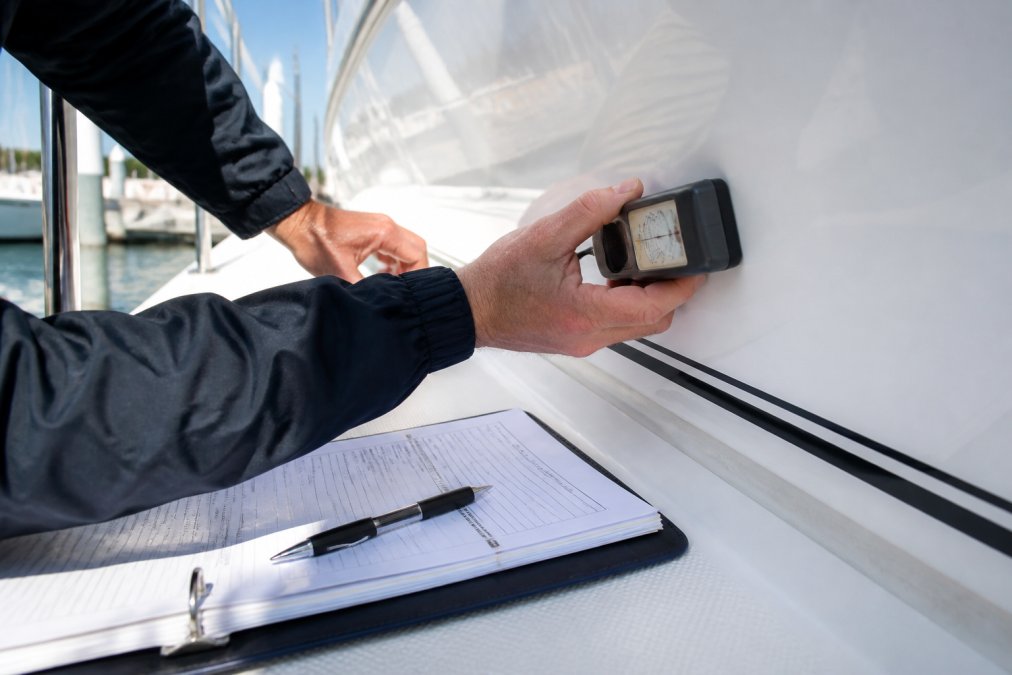
Call the surveyor directly and ask specific questions about the vessel. A legitimate surveyor remembers the boats they inspect. Ask about engine hours, hull condition, and whether a sea trial was performed. If the surveyor cannot recall basic details about a report they supposedly wrote days earlier, something is wrong.
Verify the date of the survey against the vessel's location history. If the report claims an inspection in Miami but the vessel was in Fort Lauderdale on that date, the document is fabricated. Contact the marina or yard where the survey supposedly took place, many facilities keep records of haul-outs and inspections.
Request the raw data behind the report. Legitimate surveyors keep logs from their moisture meters, ultrasonic thickness gauges, and other testing equipment. If the surveyor cannot produce this supporting documentation, the report may be based on visual inspection alone.
Step 4: Spot Yacht Survey Red Flags in the Findings
Reading the findings for red flags is where most buyers stop, but it is also where the most sophisticated fraud hides. The red flags in a legitimate survey are about condition. The red flags in a forged report are about the document itself.
The Digital Fraud Pattern: Reused and Recycled Reports
The most common scam is not a forged document from scratch, it is a recycled report. A fraudster lists a boat for sale, obtains a legitimate survey from a previous listing or a different vessel, and attaches it to the new listing. The report is real, but the document does not describe the boat you are buying.
To catch this pattern, look for these mismatches:
- Photograph cross-referencing: The survey photos show the vessel's hull color, deck layout, and hardware. Compare these photos against the listing photos. If the survey shows a white hull and the listing shows a blue hull, you have a mismatch.
- HIN in the photos: Zoom into the surveyor's photos of the hull. The HIN is often visible in the transom photo. Compare it to the HIN in the listing and on the actual vessel. A mismatch here is definitive proof of a recycled report.
- Survey date versus listing date: If the survey is dated 14 months ago and the listing claims the boat is 'freshly surveyed,' the report is stale. A buyer should never rely on a survey older than 6 months for a pre-purchase decision.
The 'Too Clean' Report Pattern
A report that lists zero deficiencies is a statistical outlier.
A more subtle red flag is the report that lists deficiencies but assigns every one a 'minor' or 'cosmetic' severity rating. A surveyor who finds a delaminated deck core and calls it 'minor wear' is either incompetent or writing to please the seller. Look for severity ratings distributed across the range, minor, moderate, and significant.
The Valuation Red Flag: Inflated Numbers
The survey's valuation section is a common place for fraud because buyers rarely question a number that supports their desire to buy. A legitimate surveyor determines fair market value using comparable sales. The report should cite comparable sales with vessel details, dates, and sale prices.
If the report states a fair market value without comparables, or if the comparables are from different regions or vessel types, the valuation is unsupported. An inflated valuation often supports an inflated asking price.
The 'Sea Trial' Red Flag: Data That Does Not Exist
A sea trial is a critical part of a pre-purchase survey for any vessel with engines. The sea trial section should include:
- Engine RPM at various throttle positions (idle, cruise, WOT)
- Temperature readings for each engine at each throttle position
- Oil pressure readings at idle and at cruise
- Speed over ground (GPS) versus speed through water (paddlewheel)
- Fuel consumption data if a flow meter was used
- Trim tab and steering system operation
- Electronics and navigation system checks
A report that says 'sea trial performed, all systems operated normally' without a single number is a placeholder. A forger writes this because they do not know what the actual numbers should be. A legitimate surveyor records the numbers because they were there.
The 'Condition Summary' Red Flag: Language That Hedges
Legitimate surveyors use precise language. They write 'the hull showed moisture readings of 18-22% in the starboard topsides, indicating water intrusion requiring further investigation.' A forged or seller-influenced report uses hedged language.
Watch for these hedge phrases that indicate the surveyor either did not perform the inspection or is deliberately obscuring findings:
- 'Appears to be' without supporting data
- 'No obvious defects' (obvious to whom, and what was not obvious?)
- 'Considered normal for a vessel of this age' (normal is not a measurement)
- 'Surveyor was unable to access' (what was not accessed, and why?)
- 'Recommend further investigation' without specifying what investigation or why
A legitimate surveyor who cannot access a space says so explicitly and explains why. A forger writes 'unable to access' as a catch-all to avoid documenting a problem they did not look for.
The Marketplace Scam Pattern: The 'Too Good to Be True' Report
In online marketplace transactions, the fraud pattern often follows a script. The seller provides a professional-looking survey report, the price is below market, and the seller pressures you to act quickly. The report is the tool that lowers your guard. To protect yourself, run this check:
- Reverse-image search the survey photos using Google Images or TinEye. If the same photos appear in other listings for different vessels, the report is recycled.
- Search the surveyor's name and the vessel's name in a web search. If the same survey appears in a previous listing for a boat that sold months ago, the report is stale.
- Call the surveyor and ask three questions: What was the vessel's HIN? What was the hull color? Were any sea trial issues noted? A legitimate surveyor answers these immediately.
The Red Flag Table: What to Look For and What to Do
| Red Flag | What It May Indicate | Action to Take |
|---|---|---|
| Zero deficiencies listed | Cursory inspection or seller-influenced report | Request a second survey |
| Vague engine descriptions | No actual mechanical testing performed | Ask for compression and oil analysis data |
| HIN mismatch with registration | Potential fraud or stolen vessel | Halt the transaction immediately |
| No photographic evidence | Report may be fabricated | Verify surveyor credentials and call them |
| Moisture readings clustered in one area | Water intrusion and possible rot | Request targeted core sampling |
| Survey photos do not match listing photos | Recycled report from a different vessel | Compare HIN in photos to actual vessel |
| Survey older than 6 months | Stale condition assessment | Commission a new survey |
| No comparable sales cited in valuation | Inflated or unsupported value | Get an independent appraisal |
| Sea trial section has no data | Sea trial may not have occurred | Request the surveyor's sea trial log |
| Surveyor cannot recall the vessel | Report may be forged | Treat the entire document as suspect |
Work through this table methodically. Each red flag is an opportunity to catch a problem before it becomes your financial responsibility.
Step 5: Run the Report Past a Second Set of Eyes
Even experienced buyers benefit from a second opinion. A different surveyor or a knowledgeable broker can spot issues you missed and provide context on whether the findings are typical for the vessel's age and usage.
If the report flags significant deficiencies, consider commissioning a second survey focused on those specific areas. This targeted approach costs less than a full survey while giving you independent confirmation of the most expensive risks. For example, if the first report notes high moisture readings on the deck, a second surveyor can perform core samples to determine the extent of the damage.
A reputable brokerage can help you interpret the findings and understand how they affect the vessel's value. At Spencer Christopher Yacht and Ship, our team of former crew and engineers regularly reviews survey reports with buyers, explaining which findings are routine and which require negotiation or a revised offer.
Bring the report to your maritime attorney as well. They can advise on how the findings affect your purchase agreement and whether the contract includes adequate contingencies. Your attorney should review the report before you sign anything, not after.
Buyer's Checklist for Report Verification
Before you finalize any purchase, run the report through this checklist. Every item should be confirmed before you commit funds.
- Surveyor's credentials verified against SAMS or NAMS directories
- Surveyor's license number confirmed and current
- Insurance certificate obtained and coverage verified
- Vessel identification number matches registration documents
- Survey date and location match the vessel's actual history
- Photographic evidence present and matches the specific vessel
- Raw data from testing equipment available on request
- Sea trial data included with specific engine readings
- Repair estimates itemized with severity ratings
- Fair market value supported by comparable sales
- Second opinion obtained on any significant deficiencies
- Maritime attorney has reviewed the report and contract
Work through this checklist methodically. Skipping even one item leaves you exposed to a risk that could have been identified before closing.
Conclusion: Trust the Process, Then Trust the Boat
Verifying a yacht inspection report is not about distrusting the seller or the surveyor. It is about protecting yourself with a process that catches errors, omissions, and outright fraud before they become your problem. The checklist and steps above give you a repeatable method for every vessel you consider.
The brokers at Spencer Christopher Yacht and Ship bring over four decades of cumulative experience to every transaction, including reviewing survey reports. Our team of USCG captains, former crew, and engineers understands what a sound vessel looks like and what a problematic report is trying to hide.
Get started with Spencer Christopher Yacht and Ship and bring your survey report to our team for an honest assessment before you commit to the purchase.
Frequently Asked Questions
Is there a central database for yacht inspection reports?
There is no Carfax-style central database for yacht inspection reports in the United States. Yacht history is scattered across multiple sources: the USCG documentation database for ownership and liens, insurance claims databases, and the surveyor's own files. Because no single repository exists, you must verify each report individually. This means confirming the surveyor's credentials, contacting them directly to validate the report's authenticity, and cross-referencing the findings with the vessel's maintenance records and sea trial data.
Can a broker verify the history of a marine survey report?
A reputable broker can help you verify a marine survey report, but the final confirmation should come from the surveyor who signed it. Your broker can contact the surveyor to confirm the report is genuine and that it was performed on the specific vessel you are buying. A broker with technical expertise, such as one with USCG captain credentials, can also review the report for inconsistencies. However, you should never rely solely on the seller's broker to validate a report, as their fiduciary duty is to the seller.
What are the common red flags in a falsified yacht inspection report?
Common red flags include missing surveyor credentials or an accreditation number that does not check out, a vessel identification number (HIN) that does not match the boat's documentation, and blurry or obviously edited photographs. Inconsistent dates between the survey and the sea trial, generic language that does not reference your specific vessel, and a report that arrives as a non-editable PDF but lacks the surveyor's direct contact information are also warning signs. If the report seems too clean, with zero deficiencies noted, request the surveyor's raw notes.
How do I cross-reference survey findings with current maintenance records?
Ask the seller or broker for all maintenance records, including engine service logs, haul-out records, and electronics installation receipts. Check that the dates of this work align with the survey's findings. For example, if the survey notes a new transmission was installed, the maintenance log should show the purchase and installation date. If the survey reports hours on the engines, compare that number to the vessel's hour meters during your sea trial. Any significant discrepancy between the report and the records warrants a direct call to the surveyor.