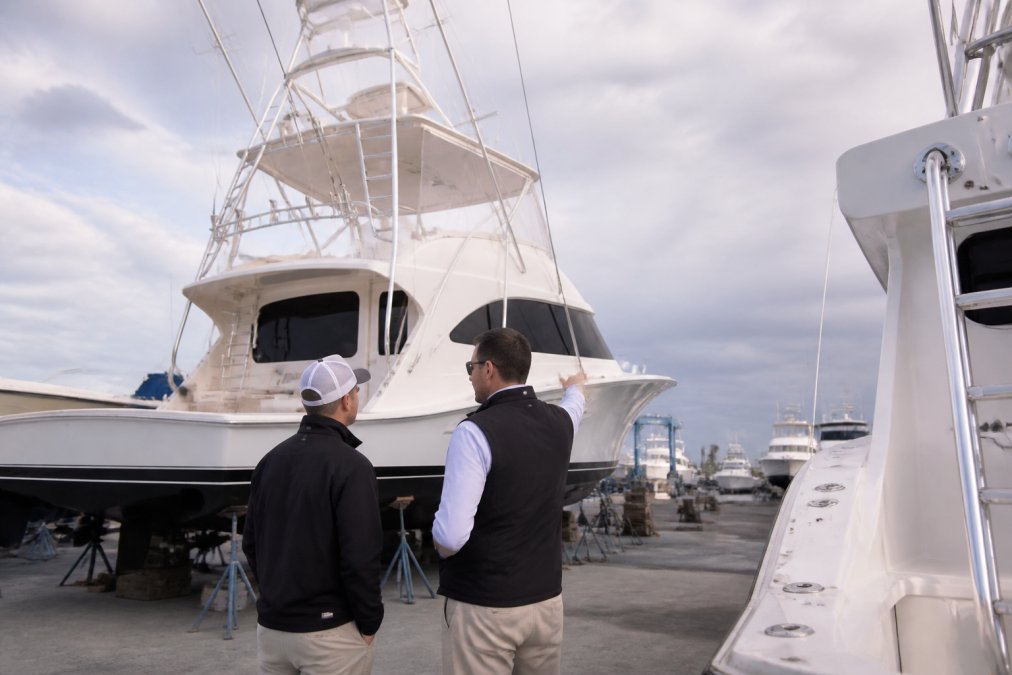
 ultimate-guide
What to Look for in Used Sportfish Yachts: 2026 Guide
Table of Contents
- Start With the Hull and Running Gear
- The Marine Survey Checklist for Sportfish: What a Proper Inspection Covers
- Cockpit, Bridge, and Fishing Systems That Decide the Deal
- Engine Hours and Sportfish Yacht Engine Maintenance Records
- Electronics, Navigation, and Redundant Systems
- The Real Cost of Owning a Sportfish Yacht After the Sale
- Interior Layout, Staterooms, and Comfort Systems
- Conclusion
- Frequently Asked Questions
Last Updated: September 10, 2026
Start With the Hull and Running Gear
The hull decides everything on used sportfish yachts. Tired gelcoat and dated electronics can be fixed with money; moisture intrusion, delamination, or a compromised transom cannot. This guide distills what USCG captains and engineers examine first when evaluating used sportfish yachts.
Walk the running gear before you admire the cockpit: shafts, struts, rudders, trim tabs, and propellers tell you how the boat was actually run.
Deadrise is the angle between the hull bottom and horizontal, measured at the transom. Deep deadrise (typically 20-24 degrees) cuts chop but burns more fuel; shallower deadrise planes easily but pounds in a head sea. For a sportfish, moderate-to-deep deadrise with a sharp entry and flared bow is the classic compromise: soft offshore ride, stable drift, predictable tracking.
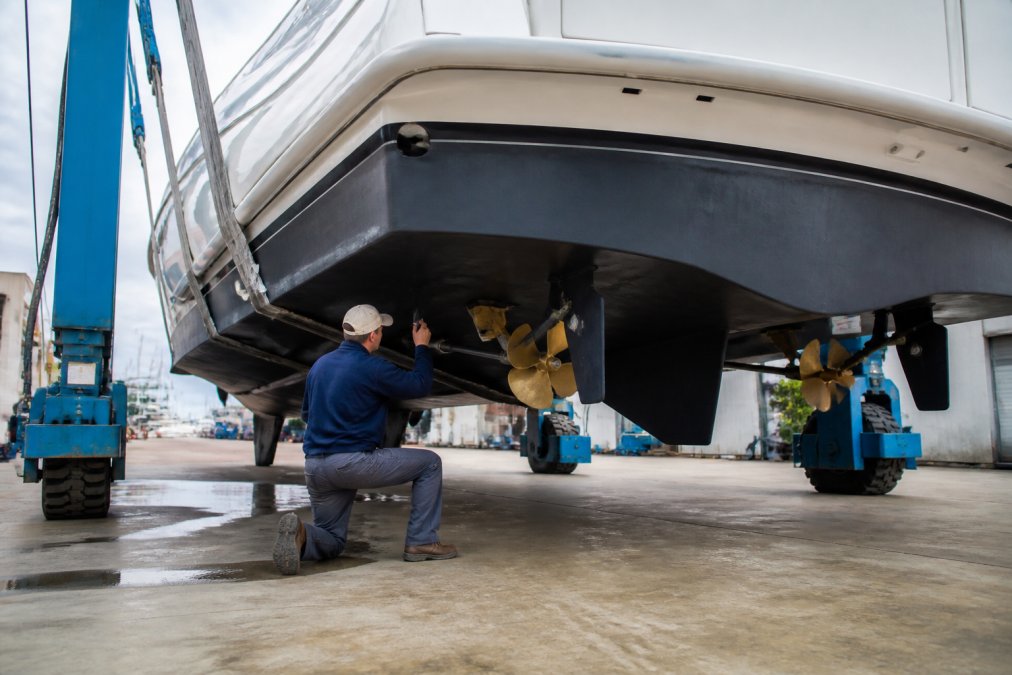
Checking Deadrise, Flared Hull Design, and Transom Condition
Flared hull design matters more than most buyers realize: flare throws spray outward and away from the cockpit, keeping crew dry in a beam sea. Run your hand along the hull sides from bow to stern; oil-canning, stress cracks at chine or strake intersections, or repaired gouges deserve a surveyor's eyes.
The transom takes the hardest beating on any sportfish. Check for:
- Stress cracks around engine mounts and transom plate bolts
- Soft spots when tapped (a dull thud instead of a sharp report)
- Corrosion staining around through-hull fittings and scuppers
- Prior repair evidence: mismatched gelcoat, sanding swirls, or filler lines
A common mistake is falling for a shiny topside paint job while ignoring the running gear underneath. Dings, bent shafts, or corroded struts hint at groundings or neglect that will resurface.
The Marine Survey Checklist for Sportfish: What a Proper Inspection Covers
A marine survey checklist for sportfish is not a formality; it is your only protection against buying someone else's deferred maintenance. Insist on a surveyor who is a member of a recognized body such as SAMS or NAMS, and attend the haul-out yourself if you can (marinesurvey.org).
The inspection covers hull integrity, structural members, electrical, plumbing, fuel systems, and machinery. Two elements are non-negotiable on a sportfish: bilge inspection and moisture testing.
Bilge Inspection, Structural Survey, and Moisture Testing
Bilge inspection reveals how the boat lives between haul-outs. Look for:
- Oil sheen or fuel odor in bilge water (engine or tank leaks)
- Rust trails from engine mounts, stringers, or fasteners
- Standing water that never drains (blocked limber holes)
- High-water marks on machinery
A structural survey taps stringers, bulkheads, and engine beds for delamination. Moisture testing flags saturated core before it becomes a rebuild; any spike near deck hardware, cleats, or the transom warrants a second look.
Cockpit, Bridge, and Fishing Systems That Decide the Deal
The cockpit is where a sportfish earns its keep, and where experienced buyers separate a fishing machine from a floating condo. Layout matters more than finish: walk the space as if fighting a fish, can a crew of three move without stepping on each other?
Fighting Chair, Tackle Center, and Bait Prep Station Setup
A fighting chair should be mounted on a reinforced, through-bolted base, not lagged into a cored deck (uscgboating.org). Check the pedestal for play, the gimbal for smooth rotation, and the footrest and harness clips for corrosion. A wobbly chair is a structural warning, not a cosmetic one.
The tackle center and bait prep station tell you how serious the previous owner was. Look for:
- Adequate drawer depth and locking hardware (salt air destroys cheap slides)
- A bait prep station with a functioning freshwater pump and cutting board
- Rod holders: count them, check welds, and confirm under-gunwale storage is dry
- Livewell and fish box plumbing: pumps, valves, and drains all working
Outriggers, teaser reels, and a tower or upper station round out the package. Inspect every weld and base plate for stress cracks; a tower is a structural system, not an accessory.
Engine Hours and Sportfish Yacht Engine Maintenance Records
Engine hours are the most scrutinized number on any used sportfish, and the most misunderstood. Low hours are not automatically good: a boat that sat idle for years can have worse internal corrosion than one run regularly with disciplined service. What matters is how those hours were accumulated and what was done along the way.
A Danger-Zone Guide to Engine Hours Versus Rebuild Intervals
The useful question is where those hours sit relative to the service life of the specific powerplant. Marine diesel rebuild intervals vary by brand and duty cycle, but a common pattern among surveyors and technicians looks like this:
- Under 1,000 hours: Low-time. The risk is inactivity, seals, hoses, impellers, aftercoolers, and fuel systems degrade when an engine sits. A low-hour engine with no records is often a bigger gamble than a higher-hour engine with a thick log.
- 1,000 to 3,000 hours: The normal working range for a well-maintained sportfish diesel. Expect documented valve adjustments, injector service, aftercooler and heat-exchanger cleaning, and raw-water pump rebuilds. Missing any is a negotiating point, not a deal-breaker.
- 3,000 to 5,000 hours: Mid-life territory. Turbochargers, injectors, and cooling systems typically need attention, and a compression or cylinder test becomes close to mandatory. A boat in this band with complete records can still be excellent value.
- 5,000 to 8,000 hours: Approaching or inside the window where many marine diesels need a top-end refresh (heads, valves, injectors) and, depending on brand and use, a full rebuild. Price the boat as if the overhaul is coming.
- Over 8,000 hours: Assume a rebuild is due or recently done. If recently done, demand the rebuild invoice, machine-shop paperwork, and break-in records. If not, treat the engine as a core and price the replacement into your offer.
These bands are not universal: a continuously run, lightly loaded engine can outlast a low-hour one that was repeatedly overheated. The hour meter is only the opening question.
Digital Diagnostic Tools and What Service Records Reveal
Modern electronically controlled marine diesels store fault history, and a technician with the manufacturer's diagnostic software can download it, one of the most underused tools in used-boat buying (PubMed). The download reveals overheat events, over-rev incidents, sensor faults, and how the engine was loaded over its life.
Arrange the download during the sea trial, not after. A technician connects a laptop to the ECM, pulls the fault log and load history, and can often tell whether the boat spent its life trolling, running hard to the canyon, or idling at the dock. Each pattern leaves a different wear signature.
For mechanical engines, service records carry the same weight. Match the hour meter to the log; a gap or unexplained reset is a red flag. If records are missing, budget for a full mechanical inspection and a compression test on every engine before you commit.
Ask the seller for the fuel transfer pump and fuel polishing history. Contaminated fuel is a quiet killer on diesel sportfish, and a boat that has never had its tanks cleaned may hand you a fuel system bill within your first season.
A clean ECM download does not replace a mechanical inspection. Software can be reset and fault codes cleared. Always pair the electronic history with a physical compression test, oil analysis, and a coolant sample before you sign.
Matching Hours to the Rest of the Boat
Read engine hours alongside the hours on the generator, air-conditioning units, and electronics. A boat showing 4,000 engine hours but 200 generator hours was run hard and rarely lived aboard, a different ownership profile than the reverse. Neither is automatically better, but the mismatch tells you how the boat was used and what systems are due.
Electronics, Navigation, and Redundant Systems
Electronics age faster than any other system aboard. A 2015-era chartplotter may still power on, but it will not run current charts or integrate with modern fish-finding electronics. Price the electronics package as a consumable, not an asset.
| System | What to Verify | Buyer's Priority |
|---|---|---|
| GPS and chartplotter | Current charts, software updates | High |
| Fish-finding electronics | Transducer condition, depth performance | High |
| Autopilot | Sea-trial function, pump condition | Medium |
| Radar | Range, target clarity | Medium |
| VHF and redundant systems | Backup radio, antenna condition | High |
| Battery bank and charging | Age, capacity, alternator output | High |
Redundant systems are not a luxury offshore. A second GPS, a backup VHF, and independent battery banks let you get home when one system fails. Verify each works independently; a "backup" wired to the same breaker is not a backup.
The Real Cost of Owning a Sportfish Yacht After the Sale
The cost of owning a sportfish yacht does not end at closing, and this is the part most buyers underestimate. Purchase price is the entry fee; ownership is the subscription. Here is how to build a realistic annual budget and how resale value interacts with everything you spend.
Building an Annual Ownership Budget
Separate sportfish ownership costs into fixed, variable, and deferred categories. Fixed costs arrive whether you use the boat or not; variable costs scale with use; deferred costs are the ones you can postpone, until you can't.
Fixed annual costs typically include:
- Slip or moorage, billed by overall length and sometimes beam
- Insurance, scaling with hull value, agreed value versus actual cash value, and cruising range
- Registration and applicable local personal property taxes
- Annual haul-out, bottom paint, and running gear service
- Winterization or year-round climate control
- Loan interest if financed
Variable costs scale with use:
- Fuel, a twin-diesel sportfish burns heavily at cruise, and a canyon run is a different budget than a bay day
- Oil and filter changes, impellers, and service tied to engine hours
- Marina transient fees, fuel dock charges, and trip expenses
- Crew or captain if you do not run the boat yourself
Deferred and surprise costs:
- Engine and generator overhauls, arriving on a schedule measured in thousands of hours
- Electronics replacement, on a five-to-ten-year cycle
- AC systems, freshwater pumps, refrigeration, and general systems upkeep
- Hull and topside repair after a hard season or grounding
New owners often budget for fuel and slip fees and forget the deferred category entirely. That is how a first season turns into a five-figure surprise.
How to Get a Realistic Number for a Specific Boat
Generic rules of thumb, a percentage of purchase price, a cost per foot, a cost per hour, are starting points, not answers. Build a real number by asking three questions about the specific vessel:
- What did the current owner actually spend last year? Ask for receipts, not estimates, service invoices, yard bills, and insurance premiums.
- What is due in the next 24 months? If the engines are at 4,500 hours, the generator is original, and the electronics are a decade old, your first two years carry costs the seller already absorbed.
- What will you actually use it for? A boat that fishes twenty days a year has a very different fuel and service profile than one that fishes sixty.
A broker who knows the model can often give a realistic annual operating estimate for the specific vessel. Ask for it in writing, and ask what assumptions it is built on.
Depreciation and Resale Value
Depreciation is real but manageable. Well-maintained, well-documented sportfish hold market value better than neglected ones, which is why service records and a clean survey are worth a premium. Boats that resell well share a profile: complete service history, recent survey, updated electronics, and a hull kept up rather than patched.
The counterintuitive point: preventative maintenance is often cheaper than the depreciation hit from a neglected boat. A buyer comparing two similar hulls will pay more for the one with records, and the gap frequently exceeds what the records cost to produce.
Treat the purchase price as the down payment on ownership, not the total cost. Build a fixed, variable, and deferred budget before you make an offer, and price the boat as if the deferred costs are already yours.
Interior Layout, Staterooms, and Comfort Systems
Interior comfort decides whether your family actually uses the boat. A tournament-ready cockpit with a cramped, dated cabin will sit at the dock. Walk the staterooms, open every hatch, and check for musty odors that signal hidden moisture.
Key checks inside:
- Stateroom berths: mattress condition, storage access, ventilation
- Head and shower: freshwater pumps, drains, and mildew
- AC systems: cooling performance and condensate drainage
- Galley: refrigeration, cooktop, and water pressure
- Headroom and sightlines from the helm
Bridge visibility and helm ergonomics deserve their own walk-through. Sit in the helm chair at cruise and trolling speed. Can you see the cockpit, teasers, and horizon without standing? Can you reach the throttle, wheel, and electronics without leaning? Visibility is a safety feature, not a convenience, especially around other boats or in low light.
Maneuverability matters at the dock and in a tight marina. Test trim tabs, bow thruster if equipped, and twin-engine handling during the sea trial.
Conclusion
Buying a used sportfish is a forensic exercise: hull and running gear first, survey and sea trial always, and a hard look at the ownership costs that follow the sale. Skip any step and you inherit someone else's problems. Spencer Christopher Yacht and Ship is an independently owned brokerage dedicated to providing unparalleled representation for buyers and sellers of sportfish yachts, center consoles, and superyachts across the Eastern Seaboard and the Bahamas. Our brokers are USCG captains, former crew, and engineers with over four decades of cumulative experience, and we provide complete fiduciary care from the first showing to delivery through our in-house closing department. Get started with Spencer Christopher Yacht and Ship and buy your next sportfish with a team that inspects it the way an owner would.
Frequently Asked Questions
What are the most common mechanical issues in used sportfish yachts?
The most frequent problems found in used sportfish yachts include worn marine diesel engines with high hours, corroded fuel transfer pumps, failing freshwater pumps, and aging AC systems. Bilge inspection often reveals water intrusion or failing through-hull fittings. Trim tabs and steering components also wear over time. A thorough marine survey and engine survey catch these before purchase, so always request service records and verify engine hours against digital diagnostics.
How important is a professional marine survey for a sportfish yacht?
A marine survey is essential. It covers hull integrity, structural survey items, and mechanical systems that a casual walkthrough misses. The surveyor checks deadrise, transom condition, and moisture levels in the hull. Without a survey, you risk buying a vessel with hidden blistering, delamination, or failing running gear. Most lenders and insurers require a survey before financing or coverage, making it a non-negotiable step in the buying process.
What should I look for when inspecting sportfish yacht engine maintenance records?
Look for consistent oil analysis reports, documented service intervals, and records of major overhauls. Engine hours matter, but so does how those hours were accumulated. A sportfish yacht with 2,000 hours of trolling is different from one with 2,000 hours at high cruise. Check for records of aftercooler service, heat exchanger cleaning, and fuel system maintenance. Missing records are a red flag that can reduce resale value and signal deferred maintenance.
How do I estimate the cost of owning a sportfish yacht after purchase?
Post-purchase costs include dockage, insurance, fuel, preventative maintenance, and haul-out fees. Engine service intervals and electronics upkeep add up quickly. Budget for annual bottom paint, zinc replacement, and AC system service. Ownership costs vary by vessel size and usage, so request a detailed cost breakdown from a broker familiar with the model. Spencer Christopher Yacht and Ship can provide guidance on ownership projections for specific vessels.