 ultimate-guide
Yacht Purchase Agreement: Legal Tips That Protect You
Table of Contents
- What a Yacht Purchase Agreement Actually Covers
- Using the IYBA Yacht Purchase Agreement Template
- Marine Survey Contingency Clauses: What to Negotiate
- Vessel Title Search and Lien Verification
- Tax Liability, Flag State Registration, and Dispute Resolution
- Yacht Closing Process Steps: From Contract to Title Transfer
- Why Legal Representation and Fiduciary Brokerage Both Matter
- Frequently Asked Questions
Last Updated: August 31, 2026
What a Yacht Purchase Agreement Actually Covers
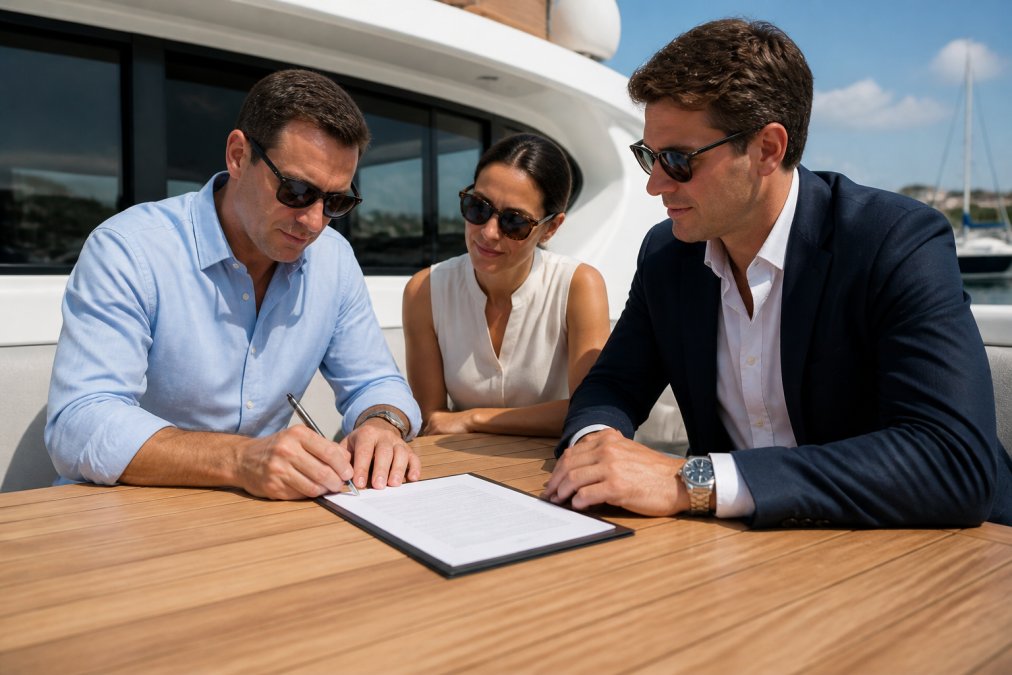
A yacht purchase agreement is a legally binding contract that defines every material term of the sale between a buyer and a seller, from the vessel's specifications and purchase price to contingencies, closing procedures, and default remedies. Get it wrong, and you're risking six or seven figures with limited legal recourse.
This guide covers the clauses that matter most, the negotiations worth having, and the legal protections that separate a clean closing from a costly dispute. These principles apply whether you're acquiring a 40-foot center console or a 100-foot superyacht.
Vessel Description, Specifications, and Inventory List
The vessel description section is where most disputes begin. A vague description creates ambiguity about exactly what the buyer is purchasing. The contract must include the vessel's full name, hull identification number, year, make, model, and flag state registration. Every piece of electronics, safety equipment, ground tackle, dinghy, tender, and fishing gear that the buyer expects to receive must be enumerated in writing. If it's not on the list, the seller has no contractual obligation to leave it aboard. On larger sportfish yachts and superyachts, the inventory can represent tens of thousands of dollars in standalone equipment value.
Purchase Price, Good-Faith Deposit, and Escrow Account
The good-faith deposit is typically held in an escrow account managed by a licensed yacht broker or maritime attorney. This neutral holding mechanism protects both parties: the buyer's funds are secured until conditions are met, and the seller has documented evidence of contractual commitment. Deposit amounts, release conditions, and forfeiture terms must all be spelled out clearly. Under what circumstances does the buyer forfeit the deposit? What triggers a full refund? What happens if the seller defaults? These provisions aren't boilerplate, they're the financial safety net for both sides.
Using the IYBA Yacht Purchase Agreement Template
The International Yacht Brokers Association standard purchase agreement is the most widely used contract form in the American yacht brokerage market. It establishes baseline language for deposit handling, survey and sea trial rights, closing timelines, and default provisions that most reputable brokers recognize and accept. Spencer Christopher Yacht and Ship, as an IYBA member, works within this framework regularly.
The template is a floor, not a ceiling. Nothing in the IYBA form prevents you from negotiating stronger protections, adding jurisdiction-specific tax provisions, or inserting custom contingency language. Treating the standard form as immutable benefits the party with more experience at the table.
| Contract Element | IYBA Standard Form | What You Can Negotiate |
|---|---|---|
| Deposit amount | Typically 10% | Percentage, timing, release conditions |
| Survey contingency | Included | Scope, inspector qualifications, timeline |
| Sea trial rights | Included | Duration, conditions, fuel responsibility |
| Acceptance of vessel | Standard language | Specific defect thresholds, repair credits |
| Closing date | Defined | Extension rights, penalty clauses |
| Dispute resolution | May vary | Arbitration forum, governing law |
Marine Survey Contingency Clauses: What to Negotiate
Marine survey contingency clauses give the buyer the right to have the vessel professionally inspected before finalizing the purchase. This is the most consequential protection in any yacht purchase agreement, and buyers who waive it are taking on undisclosed risk with no contractual remedy.
A well-drafted marine survey contingency clause should specify: the buyer's right to select a qualified, independent marine surveyor; the timeline for completing the survey (typically 7-14 days); the buyer's right to withdraw or renegotiate if material defects are revealed; the definition of "material defect"; and the process for disputing survey findings. A thorough survey creates negotiating leverage. Defects identified before closing can be remedied by the seller, credited against the purchase price, or used to justify withdrawal. Without the contingency in writing, none of those options exist.
Sea Trial Rights and Acceptance of Vessel
Sea trial rights allow the buyer to operate or observe the vessel under power before final acceptance. The contract should define the duration, who bears fuel costs, what sea conditions are acceptable, and what happens if the vessel fails to perform to specification. "Acceptance of vessel" is a defined legal moment. Once the buyer accepts, the contractual contingencies are satisfied and the transaction proceeds to closing. The language governing acceptance should be precise about what deficiencies, if any, survive acceptance and remain the seller's obligation.
Insurance Contingency and Default Provisions
An insurance contingency clause protects the buyer if the vessel becomes uninsurable between contract execution and closing. This scenario is more common than buyers expect, particularly with older vessels or those with prior casualty history. Default provisions define the consequences when either party fails to perform. A buyer default typically results in forfeiture of the good-faith deposit. A seller default should trigger full return of the deposit plus, in some contracts, additional damages. Both scenarios should be defined with equal specificity.
Vessel Title Search and Lien Verification
Vessel title search and lien verification is due diligence no buyer should skip. In the United States, documented vessels are registered with the U.S. Coast Guard's National Vessel Documentation Center, and encumbrances such as preferred ship mortgages are recorded there as a matter of public record. According to the U.S. Coast Guard National Vessel Documentation Center, a documented vessel's abstract of title provides a complete chain of ownership and discloses any recorded liens or mortgages against the hull. A clean abstract is a prerequisite for clear title transfer at closing.
State-registered vessels require lien searches at the appropriate state registry. Many buyers of smaller vessels overlook this step, then discover post-closing that they've inherited a lender's security interest.
The practical steps for a thorough title search are:
- Obtain the vessel's USCG documentation number or state registration number
- Request an abstract of title from the National Vessel Documentation Center for documented vessels
- Conduct a UCC lien search in the seller's state of domicile
- Verify that any recorded mortgages will be discharged at or before closing
- Confirm the seller has authority to convey title
Tax Liability, Flag State Registration, and Dispute Resolution
Tax and registration issues are where yacht transactions get genuinely complex, and where the absence of legal representation creates the most expensive mistakes.
Sales Tax, Use Tax, and Documentation Fees
Sales tax and use tax liability on yacht purchases varies significantly by state. The location where the vessel is delivered, used, and registered all factor into the analysis. The Federation of Tax Administrators state sales tax guide provides a reference point for comparing state-level treatment, but the specific application to any transaction requires professional tax advice. A yacht purchase agreement should address which party bears tax liability and how documentation fees are allocated at closing. A common approach is to include a tax indemnification clause that clarifies each party's responsibility.
Flag State Registration and Jurisdiction Clauses
Flag state registration determines which country's maritime law governs the vessel's operation, crew requirements, and safety standards. For vessels operating primarily in U.S. waters, USCG documentation under the U.S. Coast Guard National Vessel Documentation Center is the standard path. The jurisdiction clause specifies which state's law governs contract disputes. Florida, for example, has well-developed maritime commerce law and a deep bench of experienced maritime attorneys. Agreeing to jurisdiction in an unfamiliar state creates practical difficulties if a dispute arises.
Arbitration and Contractual Breach Remedies
Arbitration clauses route disputes to a private arbitration forum rather than the court system. For high-value yacht transactions, arbitration often offers faster resolution and greater confidentiality than litigation. The contract should specify the arbitration forum, the number of arbitrators, the seat of arbitration, and whether the decision is binding. Contractual breach remedies should be defined for both buyer and seller default scenarios. Some agreements include liquidated damages provisions that specify a pre-agreed amount the breaching party owes, enforceable when they represent a reasonable estimate of actual harm rather than a penalty.
Yacht Closing Process Steps: From Contract to Title Transfer
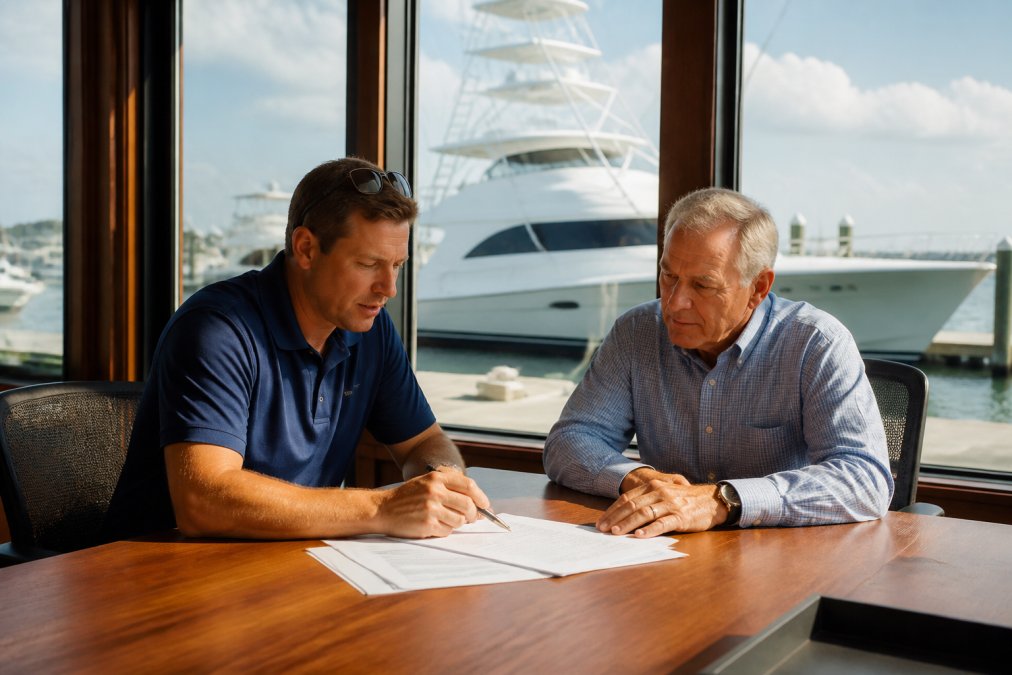
The yacht closing process is the sequence of actions that converts a signed purchase agreement into a completed title transfer. A clean closing requires coordination between the broker, the closing department, the maritime attorney, the lender (if financing is involved), and both parties.

The yacht closing process steps, in order, are:
- Satisfy all contingencies - marine survey acceptance, sea trial completion, insurance confirmation
- Conduct title and lien search - confirm clear title and arrange discharge of any recorded encumbrances
- Prepare closing statement - itemize purchase price, deposit credit, prorated expenses, and fees
- Execute bill of sale - seller signs and delivers the bill of sale transferring ownership
- Fund the transaction - buyer wires remaining balance to escrow; escrow releases funds to seller
- Complete USCG documentation - submit transfer of documentation or state registration forms
- Deliver the vessel - physical delivery at agreed location, with inventory confirmed against contract list
The closing statement should account for prorated insurance, fuel, and any credits negotiated based on survey findings. Discrepancies between the closing statement and the original purchase agreement are a common source of last-minute friction.
Why Legal Representation and Fiduciary Brokerage Both Matter
Most buyers approach a yacht transaction with one of two professionals: a broker or an attorney. The strongest transactions use both, with clearly defined roles. A maritime attorney provides independent legal advice on contract terms, tax structure, flag state registration, and dispute resolution provisions. A broker's role is transaction management: sourcing the vessel, negotiating price, coordinating survey and sea trial logistics, and managing the closing process.
A broker who represents both buyer and seller simultaneously has competing obligations. A fiduciary broker represents one party exclusively and is legally and ethically bound to prioritize that party's interests. Spencer Christopher Yacht and Ship operates on this model: complete fiduciary care from the first showing through final delivery, with an in-house closing department that manages documentation and title transfer without outsourcing critical steps.
For buyers who already have a trusted maritime attorney, that relationship should be preserved and welcomed by any broker worth working with. An attorney who reviews the purchase agreement and a fiduciary broker who manages the transaction complement each other. The quality of representation at the contract stage determines the quality of every subsequent negotiation. Survey findings, sea trial deficiencies, and closing adjustments all get resolved within the framework the purchase agreement creates. A well-drafted agreement with strong contingency clauses gives your team room to negotiate.
Yacht transactions at the level of sportfish vessels and superyachts involve enough complexity and capital that the contract stage is not where to economize on professional guidance. The Spencer Christopher Yacht and Ship team brings USCG-licensed captains, engineers, and a dedicated in-house closing department to every transaction, combining the technical knowledge to evaluate a vessel's true condition with the legal and administrative infrastructure to close it cleanly. If you're preparing to buy or sell, contact us to discuss how fiduciary representation changes the outcome.
Frequently Asked Questions
What are the essential clauses to include in a yacht purchase agreement?
A complete yacht purchase agreement should include a precise vessel description with specifications and inventory list, the purchase price and good-faith deposit terms, escrow account details, marine survey and sea trial contingency clauses, title transfer and lien-free warranty language, default provisions for both buyer and seller, closing date, and a jurisdiction or arbitration clause. Omitting any of these leaves one party exposed to significant financial or legal risk. The IYBA standard template covers most of these, but your specific transaction may require additional riders.
Why is a marine survey contingency critical in a yacht contract?
A marine survey contingency gives the buyer the contractual right to hire a certified marine surveyor to inspect the vessel before the sale closes. If the survey reveals material defects, the buyer can negotiate repairs, a price reduction, or walk away and recover the deposit. Without this clause, you accept the vessel in its current condition regardless of what a survey later uncovers. For high-value sportfish yachts and superyachts, a thorough survey can identify structural, mechanical, or electrical issues worth tens of thousands of dollars.
How does a yacht purchase agreement protect against undisclosed liens?
A properly drafted yacht purchase agreement requires the seller to warrant that the vessel will be delivered free and clear of all liens, encumbrances, and claims. This is backed up by a vessel title search through the USCG National Vessel Documentation Center before closing. Any recorded mortgages or maritime liens must be satisfied and discharged at or before the closing date. Your escrow agent typically holds funds until a clean title is confirmed, preventing the buyer from inheriting another party's debt obligations tied to the vessel.
Can I draft my own yacht purchase agreement?
Technically yes, but it carries real risk on a high-value asset. A self-drafted contract may omit critical protections like survey contingency clauses, proper escrow instructions, or enforceable default provisions. Maritime law adds another layer of complexity, particularly around USCG documentation, flag state registration, and jurisdiction. Most transactions use the IYBA standard form as a baseline, then a maritime attorney or experienced closing department customizes it for the specific vessel and parties. For any purchase above a modest dollar threshold, professional legal representation is worth the cost.